Showing posts with label geometry. Show all posts

Wednesday, December 2, 2009

Geometry: How can we prove right triangles?

Geometry:  
How many right angles are possible in a right triangle? Plot a triangle on the coordinate plane and prove that a right angle exists by finding the slopes of the two sides that make it. Be careful not to confuse length with steepness. How can a right triangle also be isosceles? 
  1. Assignment: Worksheet
  2. Test on Thursday!

Geometry: How can we prove isosceles & equiliateral triangles?

Geometry:  
What is the definition of isosceles and equilateral? Plot a triangle on the coordinate plane and use the Distance Formula or the Pythagorean Theorem to prove that you have at least two sides congruent. Careful, sometimes you can just count the length of each side. Write a conclusion to explain your work.
  1. Assignment: Worksheet
  2. Test on Thursday!

Monday, November 23, 2009

Geometry: How do we solve for angles & sides of isosceles & equilateral triangles?

Geometry:  
What is the relationship between the base angles of an isosceles triangle? What are the definitions of equilateral and equiangular? Review the converse of theorems about isosceles & equilateral triangles. Set up algebraic equations to solve for missing angles and sides using these theorems. 
  1. Assignment: p. 239 - 240 / 1 - 9, 17, 18, 19, 22, 23

    Thursday, November 19, 2009

    Geometry: How can we prove two triangles are congruent?

    Geometry:  
    Good job on your quiz! Let's prove triangles are congruent using the Hypotenuse-Leg Postulate. Careful you may only use this for right triangles. Also, what do you know about the other corresponding parts of congruent triangles? Are they congruent after you prove two triangles are congruent?
    1. Assignment: Worksheet.

    Friday, November 13, 2009

    Geometry: How can we prove two triangles are congruent?

    Geometry:  
    Station Activity: Work in groups and rotate to each station with your recording sheet. In Station A, complete two-column proofs with SSS or SAS; in Station B, with ASA or AAS; and in Station C, complete critical thinking questions about corresponding parts of congruent triangles.
    1. Quiz on Tuesday!

    Thursday, November 12, 2009

    Geometry: How can we prove two triangles are congruent?

    Geometry:  
    Let's add two more postulates to help use prove two triangles are congruent: A.S.A. and A.A.S. Complete two-column proofs using definitions and relationships between certain angles in the triangles. Analyze diagrams and decide whether there is enough information to prove two triangles congruent; if so, could you use S.S.S., S.A.S., A.S.A., or A.A.S.
    1. Assignment: p. 223 / 5, 6, 8 - 13 and p. 210 / 1 - 4

    Tuesday, November 10, 2009

    Geometry: How can we prove two triangles are congruent?

    Geometry:  
    Let's practice more proofs where we can use the S.S.S. or S.A.S. Postulates. Work with a partner and complete a two-column proof by matching statements with reasons. Always pay attention to what you know to be true and what you may be assuming to be true. Check your partner's work and share your solutions!
    1. Assignment: Two-column proofs.

    Monday, November 9, 2009

    Geometry: How can we prove two triangles are congruent?

    Geometry:  
    How do we prove two triangles are congruent? If you know three corresponding sides are congruent, then you can use the Side-Side-Side Postulate. If you know two corresponding sides and the included angle are congruent, then you can use the Side-Angle-Side Postulate. There is a HUGE difference between what we know (ex: Definition of midpoint, Reflexive Property, etc.) and what we accidentally assume.
    1. Assignment: p. 216 - 217 / 12 - 17, 20, 21

    Wednesday, November 4, 2009

    Geometry: What are the congruence properties for congruent triangles?

    Geometry:  
    Can we use the definition of congruent and identify corresponding parts of congruent triangles? What are some examples of the reflexive, symmetric, and transitive properties given congruent triangles? Let's review the interior angle sum of a triangle and the Exterior Angle Theorem
    1. Assignment: Practice 4.2 A.
    2. Quiz on Thursday!

    Tuesday, November 3, 2009

    Geometry: What is the definition of congruent? What are the corresponding parts of congruent triangles?

    Geometry:  
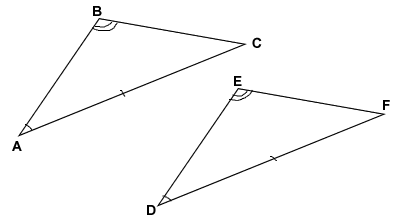
    Let's review the interior angle sum of a triangle. Can you set up an algebraic equation to solve for x if x represents the measure of an interior angle of a triangle? What if x represents the measure of an exterior angle of a triangle? What is the definition of congruent and how can you use notation or symbols to identify corresponding parts? Example: List the corresponding congruent parts of the two triangles below.


    1. Assignment: See worksheet.

    Monday, November 2, 2009

    Geometry: How do we classify triangles by their sides & angles?

    Geometry:  
    What is your first name and last name and how does your name define you? Apply this idea to a particular triangle. Classify triangles by giving them first and last names after analyzing their sides and angles. What makes a triangle isosceles, equilateral or scalene? Acute, right, obtuse, or equiangular?

    1. Assignment: Practice 4.1 A Worksheet

    Thursday, October 29, 2009

    Geometry: How do we write the equations of perpendicular bisectors of line segments?

    Geometry:  
    What is a perpendicular bisector? How can we use the equation of a perpendicular line and the midpoint of a line segment to write an equation of a perpendicular bisector?

    1. Assignment: Worksheet.
    2. Test corrections (due: 11/5/09)!

    Tuesday, October 27, 2009

    Geometry: What concepts have we mastered in coordinate geometry?

    Geometry:  
    Let's review how to find the length & midpoint of a line segment. Is the length always positive? Can a line or ray have a midpoint? Also, let's determine whether two lines are parallel or perpendicular (or neither); and write equations of parallel & perpendicular lines. Why do you think vertical & horizontal lines are perpendicular? Why are the lines y = 2 and y = -4 parallel?

    1. Test tomorrow!

    Monday, October 26, 2009

    Geometry: How do we find the length and midpoint of line segments?

    Geometry:  
    How can we use the ideas from the pair share activity to find the length & midpoint of line segments? How is the Distance Formula related to the Pythagorean Theorem? Why is the midpoint of a segment the average of the x- and y-coordinates? Which method works the best for you?

    1. Assignment: Worksheet #16, 18 and p. 38 / 18, 20, 22, 25
    2. Test on Wednesday!

    Thursday, October 22, 2009

    Geometry: How do we review parallel & perpendicular lines?

    Geometry:  
    Let's begin reviewing for our test next week. Take a chance at the spinner and you may land on "Fun & Games!"
    1. Assignment: Finish worksheet.
    2. Test next week!

    Wednesday, October 21, 2009

    Geometry: How do we write the equations of perpendicular lines?

    Geometry:  
    Investigate the slopes of perpendicular lines. Write the equation of a line perpendicular to an original line through a given point. Use the opposite reciprocal slope and the point to find the appropriate y-intercept. Perpendicular lines do not have the same slopes.
    1. Assignment: p. 175 - 176 / 9 - 24 (multiples of 3), 38, 40
    2. Test next week!

    Tuesday, October 20, 2009

    Geometry: How do we write the equations of parallel lines?

    Geometry:  
    Investigate the slopes of parallel lines. Write the equation of a line parallel to an original line through a given point. Use the same slope and the point to find the appropriate y-intercept. Parallel lines have the same slopes.
    1. Assignment: Practice 3.6 B

    Monday, October 19, 2009

    Geometry: What kinds of slopes do parallel & perpendicular lines have?

    Geometry:  
    Let's review how to find the slope between two points and graphing linear equations in y=mx+b form. Then we will investigate the slopes of parallel & perpendicular lines given special conditions (i.e., parallel to the original line, parallel to the original line through a specific point, etc.).

    1. Assignment: p. 168 / 4 - 6, 9, 11 - 14, 18, 24

    Thursday, October 15, 2009

    Geometry: What kind of reasons can we use (and reuse) in proofs?

    Geometry:  
    Complete proofs about supplementary, complementary, and vertical angles, and line segments. Review for quiz.

    1. No homework.
    2. Quiz on Friday!

    Wednesday, October 14, 2009

    Geometry: What kind of reasons can we use (and reuse) in proofs?

    Geometry:  
    When do we use congruence properties in two-column proofs about segments and angles? What are the definitions of supplementary & complementary angles and how can we use these definitions in proofs?

    1. Assignment: Practice 2.6 B / 1 - 12.
    2. Quiz on Friday!

    Search This Blog